


Why most detox programmes ignore basic liver physiology - and what actually works
Last week, a client sat in our clinic describing a pattern I’ve heard dozens of times.
She’d followed a seven-day juice detox perfectly. Expensive organic juices, lots of water, complete commitment. By day three, the headaches started. By day five, she couldn’t concentrate in meetings. Two weeks later, she’d gained back everything she’d lost plus developed new digestive symptoms.
“Everyone said the headaches meant it was working,” she told me.
But that’s not what was happening. The programme had mobilised stored toxins from her fat tissue through phase 1 – but without protein, her liver couldn’t complete phase 2 to actually eliminate them. So those toxins just recirculated, causing the exact symptoms she was trying to avoid.
We see this all the time in our Functional Medicine and Nutritional Therapy clinics. Well-intentioned programmes that ignore how the liver actually works.
Here’s what’s really going on – and what to do instead.
Your Liver Is Already Detoxifying - Right Now

Your liver is processing toxins as you read this.
Every minute, it filters over a litre of blood, converting waste products and environmental chemicals into forms your body can eliminate.
This isn’t something you need to ‘activate’ with a cleanse. It’s already happening.
The question isn’t whether you’re detoxifying. The question is: how efficiently?
Detoxification reactions are controlled by enzymes – and these enzymes dictate how fast or slow the reactions occur.
Your genetics determine how well you produce these enzymes. Some people have naturally efficient detox pathways. Others have genetic variations (like MTHFR or COMT) that slow specific enzymes down.
Then there’s the matter of total toxic load: the sheer volume of substances your liver has to process at any given time – hormones, pesticides from food, alcohol, medications, environmental chemicals from household products, bacterial toxins from your gut.
When your detox enzymes are overwhelmed – either because they’re genetically slower, lack the nutrient cofactors they need to function, or because the toxic load is too high – the system backs up. That’s when symptoms appear.
And that’s exactly what happens when someone follows a detox programme that pushes phase 1 without supporting phases 2 and 3.
When Your Liver Can’t Keep Up: Common Symptoms
When detox pathways are overwhelmed or under-resourced, your body sends clear signals and your liver is communicating that something needs attention.
You might experience:
- Obesity or inability to lose weight
- Nausea
- Bloating
- Constipation
- Low mood
- Foggy brain
- Headaches
- Migraines
- Low energy / Chronic fatigue syndrome
- Fibromyalgia
- Allergies
- Autoimmune conditions
- PMS, PMDD, heavy menstrual periods, hot flushes
- Cholesterol level abnormalities
- High blood pressure
- Dark circles under eyes
- Skin conditions such as acne and eczema
Apply for your free 15 minute Discovery Call with Dee Brereton-Patel now
The symptoms vary depending on which phase is struggling, what toxins are accumulating, and your individual biochemistry.
This is why connecting these seemingly unconnected dots – understanding that your migraines, hormone issues, and digestive symptoms might all stem from the same root cause – is the foundation of the Coho Functional Medicine approach.
Your liver handles an enormous workload every single day – not just from the occasional glass of wine or Friday night takeaway, but from constant low-level exposure to substances your body needs to neutralise:
- Cellular debris
- Pesticides, herbicides, additives, preservatives
- Our own ‘used’ hormones
- Environmental chemicals such as:
- Drugs (prescription, over-the-counter, recreational)
- Cigarette smoke (direct or secondhand)
- Alcohol
- Toxins produced by gut bacteria, mould spores
- Heavy metals: mercury, arsenic, cadmium, lead
- Chemicals from paint, flame retardants, cosmetics and household cleaning products
Here’s the critical part: most of these substances are fat-soluble. They dissolve in fat, not water – which makes them difficult to eliminate. Your body stores them in adipose (fat) tissue and cell membranes, where they can accumulate for years.
They’re only released when you lose fat, experience high stress, exercise intensely, or – here’s where detox programmes come in – when you fast or dramatically reduce calories.
And this is where things can go very wrong.
When phase 1 processes these fat-soluble toxins, it doesn’t make them safer – it makes them more reactive.
These intermediate compounds (called phase 1 metabolites) are actually more toxic than the original substances. The phase 1 reactions generate reactive oxygen species (free radicals) as byproducts.
Your body might be able to handle this oxidative stress – if you have adequate antioxidant levels.
Vitamins C and E, glutathione, selenium, and phytonutrients from colourful vegetables all help neutralise these free radicals.
But even with good antioxidant status, we still need to hand those phase 1 metabolites off to phase 2 as quickly as possible – they’re temporary intermediates that shouldn’t be hanging around.
The problem with most detox programmes is they restrict food (and therefore antioxidants) at the exact moment your body needs them most. Combine that with inadequate protein for phase 2, and you’ve got a perfect storm – highly reactive metabolites circulating with insufficient antioxidant protection and nowhere to go.
This is exactly what happened to the client I mentioned at the start. Her juice cleanse mobilised stored toxins and activated them through phase 1 – while simultaneously restricting the protein and diverse nutrients her body needed to process them safely.
The Three-Phase Detoxification System
Your liver processes toxins through three distinct phases:
Phase 1: Makes toxins more water-soluble (and also more reactive)
Phase 2: Packages activated toxins for safe elimination (conjugation)
Phase 3: Transports packaged toxins out of cells into bile and urine
But there’s another vital step: Even if all three phases work perfectly, if you’re constipated, those packaged toxins in your bile get reabsorbed back into circulation – a process called entero-hepatic recirculation. This is particularly problematic for hormones like oestrogen.
When phase 1 runs faster than phase 2 can handle, there’s a lack of antioxidants or when constipation allows toxins to recirculate, symptoms appear.
Here’s what’s happening in each phase:

Each phase depends on specific enzymes and nutrients.
When any are missing or depleted, the system slows down.

Supporting all three phases requires multiple nutrients working together.
When done properly – with your body’s physiology in mind, not a one-size-fits-all programme – this approach can be genuinely helpful whether you’re managing chronic symptoms or simply optimising your health.
Phase 1 Liver Detoxification - Making Toxins More Water-Soluble

Phase 1 is where the Cytochrome P450 (CYP450) family of enzymes get to work. These enzymes take fat-soluble toxins and chemically modify them – to make them more water-soluble, preparing them for phase 2.
Here’s the catch: in the process of making toxins more water-soluble, they also become less stable i.e. become more reactive.
These intermediate metabolites are actually more toxic than what you started with, and more free radicals are generated.
This increased reactivity is a necessary step – but it’s why these metabolites need to move quickly into phase 2.
Due to the high levels of free radicals produced during phase 1 reactions, your antioxidant status is important.
Your genetics determine how efficiently you produce specific CYP450 enzymes. Some people naturally have faster phase 1 activity; others are slower. Both can be problematic if phase 2 can’t match the pace.
Phase 1 enzymes also require specific nutrient cofactors to function: B vitamins (particularly B2, B3, B6, B12), folate, glutathione, and flavonoids.
A small amount of these metabolites can be excreted directly through the kidneys. But the majority need to move quickly into phase 2 for conjugation – otherwise those reactive intermediates circulate and cause oxidative damage.
This is exactly why juice cleanses backfire. They push phase 1 hard (higher vitamins, antioxidants, minerals from the juices) – but simultaneously starve phase 2 of the protein required to process what phase 1 produces.
Phase 2 Detoxification - Conjugation (packaging for elimination)
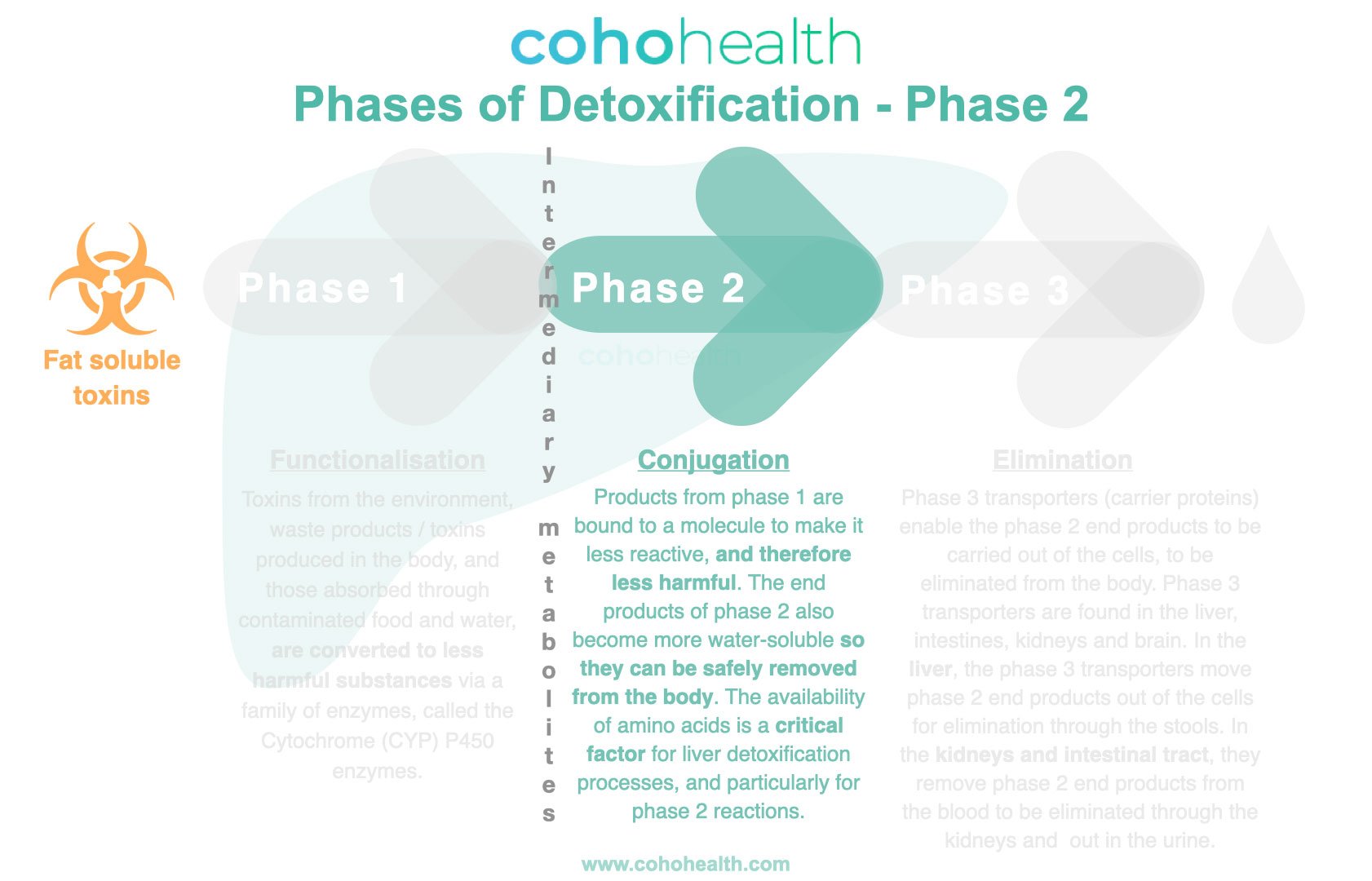
Phase 2 is where the reactive metabolites from phase 1 get ‘packaged’ for safe elimination.
Various enzymes attach molecules to these metabolites – making them less reactive, more water-soluble, and ready for excretion.
This process is called conjugation, and it happens through six main pathways, each using different enzymes and nutrients.
The Phase 2 Detox Pathways
There are six phase 2 detox pathways, each reliant on specific liver enzymes and nutrient co-factors:
Glucuronidation (processes oestrogen, many medications, environmental chemicals).
Glutathione conjugation (handles heavy metals, some hormones, oxidative stress).
Sulfation (processes neurotransmitters, some medications, toxins).
Methylation (via enzymes like MTHFR and COMT – detoxes oestrogen, heavy metals, stress hormones).
Amino acid conjugation (uses glycine and glutamine).
Acetylation (processes caffeine, certain medications).
Which pathways matter most depends on your specific health concerns.
Hormonal issues like PMS or oestrogen dominance often point to glucuronidation and methylation struggles.
Chronic headaches or chemical sensitivities suggest glutathione conjugation problems.
Mood issues and anxiety can indicate methylation pathway issues.
Here‘s what’s critical: phase 2 requires adequate protein.
The amino acids from dietary protein are the raw materials for conjugation. Without them – or if you have poor digestion that limits absorption – phase 2 cannot function properly.
This is why juice fasts can cause more harm than good: phase 1 mobilises toxins, but phase 2 runs out of resources to process them.
This is why juice fasts can cause more harm than good: phase 1 mobilises toxins, but phase 2 runs out of resources to process them.
Phase 2 enzymes are also regulated by Nrf2, a master protein that activates detoxification genes.
Sulforaphane from cruciferous vegetables like broccoli directly activates Nrf2, which is why these vegetables are central to effective detox support.
Want to know exactly which foods and nutrients support each specific pathway?
We break down all six conjugation pathways – including targeted nutrition and supplement strategies for each – in our free Liver Support Guide (download link coming soon).
Apply for your free 15 minute Discovery Call with Dee Brereton-Patel now
Phase 3 Detoxification - Transport & Elimination

Phase 3 is the final step – and one that’s often completely overlooked in detox programmes.
Even after phase 2 has packaged toxins safely, they still need to get out of your liver cells and into bile or urine for elimination.
This is where phase 3 transporters come in – specialised carrier proteins that actively pump conjugated toxins out of cells.
These transporters work throughout your body: in the liver (moving toxins into bile), in the intestines (preventing reabsorption), and in the kidneys (eliminating toxins through urine).
Here’s where gut health becomes critical.
Phase 3 transporters in your liver dump toxins into bile, ready for elimination.
If your gut bacteria are healthy and you’re eating enough fibre, those toxins bind and exit through your stool.
But if you have gut dysbiosis (bacterial imbalance), those ‘packaged’ toxins can be unwrapped by harmful bacteria and reabsorbed back into circulation – the entero-hepatic recirculation we mentioned earlier.
Phase 3 function is supported by healthy gut bacteria, adequate fibre intake, and maintaining proper bile flow.
There are some interventions that may support phase 3 transporters:
- Prebiotics
- Intermittent fasting
- Specific probiotic strains (such as bacillus spores)
So what can go wrong during your detox?

When phase 1 runs faster than phases 2 and 3 can handle, reactive metabolites accumulate and recirculate – creating oxidative stress and tissue damage.
This is the biochemical reality behind common ‘detox’ symptoms like:
- Headaches
- Bloating
- Diarrhoea
- Constipation
- Fatigue
- Foggy brain
- Skin rashes or spots
- Weight gain
- Poor sleep quality
Supporting Your Liver Properly
Now that you see how the three phases work – and why they need to work together – let’s talk about the right approach.
The Non-Negotiable First Step: Fix Elimination
Before considering any detox support, your bowels need to be moving at least once daily.
Without this, conjugated toxins get reabsorbed back into circulation – undoing all the work your liver just did.
If you’re not having complete bowel movements daily, start here:
- Stress reduction
- Daily movement
- Fibre rich vegetables at each meal
- Probiotics
- Adequate hydration - around 2 litres or a useful guide is body weight (kg) x 0.033
- Consider magnesium citrate (300mg before bed) if no medications/medical conditions
Once elimination is working, supporting detoxification properly requires:
Adequate protein at every meal (phase 2 cannot function without amino acids).
Cruciferous vegetables daily (activate Nrf2 and support phase 2 pathways).
Diverse, colourful vegetables for antioxidant protection against oxidative stress.
For people with chronic symptoms that haven’t responded to foundational support such as:
- Recurrent migraines
- Allergies
- Inflammatory skin conditions
- Stubborn hormone imbalances
- Autoimmune conditions
pinpointing liver enzymes that are not functioning optimally due to your unique genetics can be very helpful.
Identifying detoxification enzymes that need support – like MTHFR, COMT, GST – can allow for personalised protocols.
This means that we can tailor supplemental support to your specific needs – addressing the exact enzyme pathways that are struggling rather than taking a generic approach.
Apply for your free 15 minute Discovery Call with Dee Brereton-Patel now
The wrap
Your body is already detoxifying every single day – right now, as you read this.
The question has never been whether you need to detox. The question is: are you supporting the process properly, or are you inadvertently making things worse?
Most detox programmes fail because they ignore basic liver physiology.
They push phase 1 without supporting phase 2. They restrict the very nutrients your body needs most. They overlook gut health and elimination.
What you’re trying to eliminate matters too.
Heavy metals like mercury or cadmium require different support than hormones.
Pesticides are processed differently than bacterial toxins or medications.
This is why one-size-fits-all programmes often fall short – and why understanding which pathways you need to support is so important.
When done properly – with your body’s actual requirements in mind – supporting detoxification can be genuinely helpful. But it requires understanding all three phases, ensuring adequate nutrition, and addressing gut health and elimination first.
Start with the foundations:
- Fix constipation before anything else
- Prioritise protein at every meal
- Eat cruciferous vegetables daily
- Stay well hydrated
From there, the free Liver Detox Guide (coming soon) will walk you through each step in detail – including timing, specific foods for each pathway, and supplement strategies to consider.
For those dealing with chronic symptoms or complex health issues, personalised support through our Coho you=1 approach may be your next step.
Important safety note – If you take medications (including the oral contraceptive pill), have a diagnosed medical condition, or have a compromised immune system, speak with a qualified practitioner before starting any detox programme or supplement protocol. Pregnant or breastfeeding women should not follow detox programmes.
To your healthier future,
Dee & the Coho Health team

How can we help you? Send us a message below and we’ll come right back to you…
